Do Gamers Have Faster Reaction Times?
Walk into any conversation about esports and someone will eventually say it, gamers have faster reflexes than everyone else. It’s one of those claims that sounds obviously true, and honestly, it mostly is. But the real answer is a little more interesting than a flat yes, and understanding why matters if you’re trying to figure out whether picking up a controller could actually make you quicker in real life too.
The Short Answer
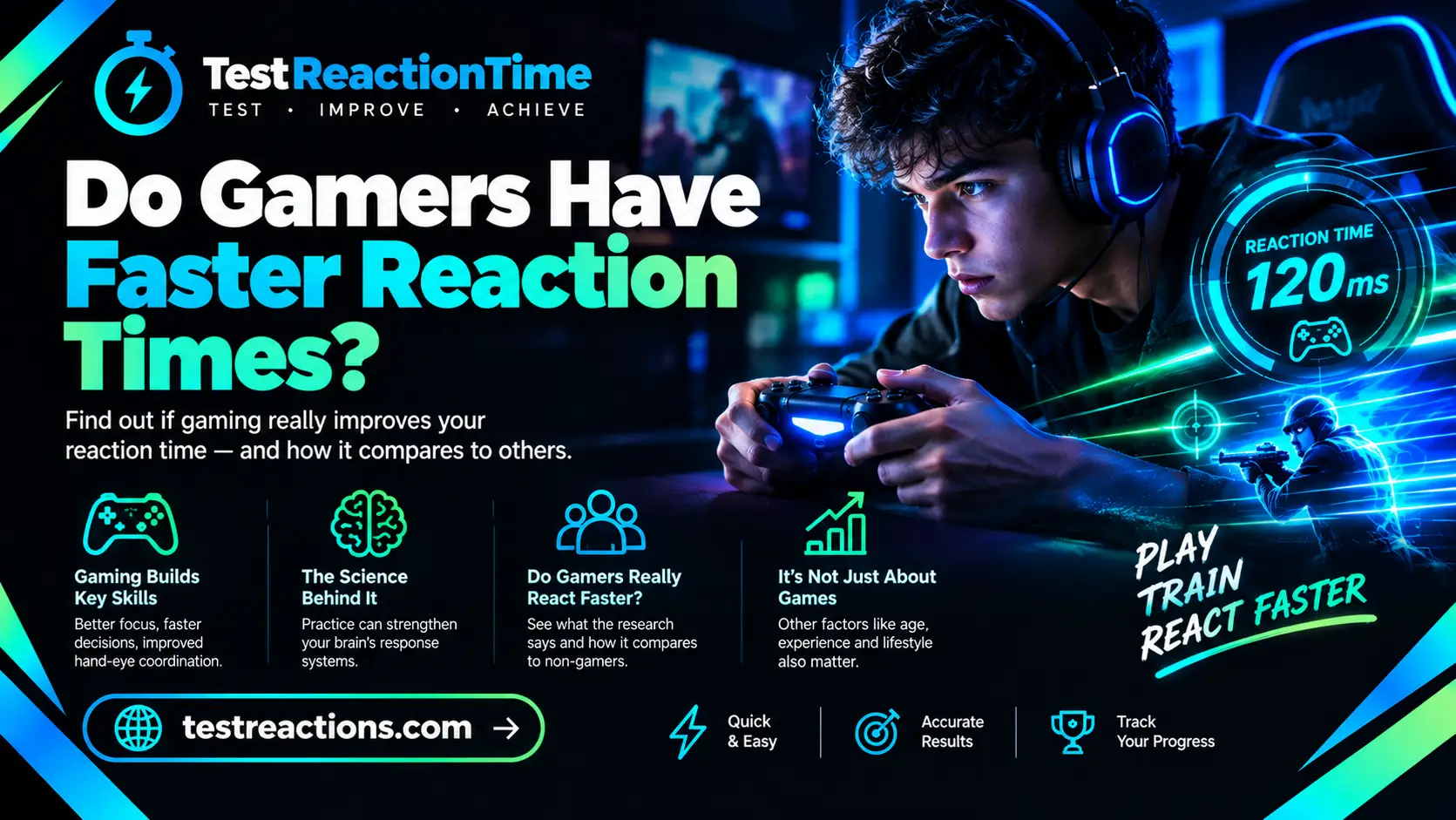
Often, yes, especially for people who play fast paced, competitive games. On visual reaction tests, action and competitive gamers frequently post noticeably quicker average scores than people who rarely game. That said, this doesn’t mean gaming automatically makes every single person faster at every kind of reaction, and it definitely doesn’t mean picking up a controller for a weekend will turn anyone into a pro. The relationship is real, but it’s more nuanced than a simple headline suggests.
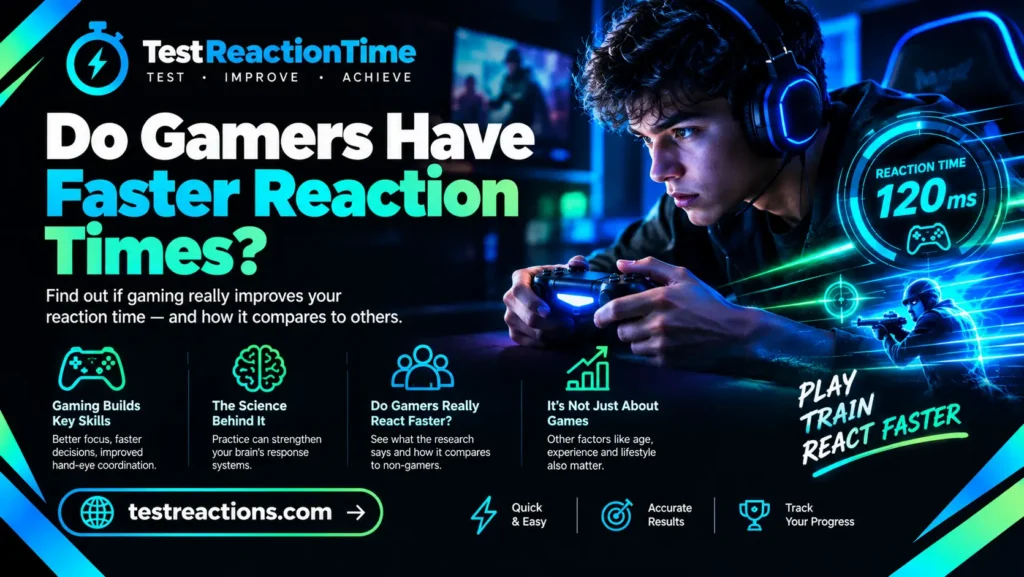
Gamers vs Non-Gamers: What the Numbers Actually Show
Here’s a rough breakdown of how these two groups typically compare on a standard visual reaction time test.
| Group | Typical Reaction Time |
|---|---|
| Professional esports players | 120 to 180 ms |
| Regular competitive gamers | 150 to 200 ms |
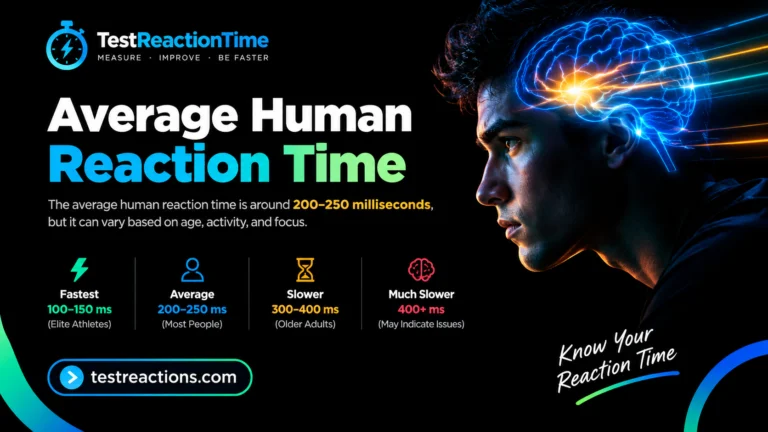
| General population (non-gamers included) | 200 to 250 ms |
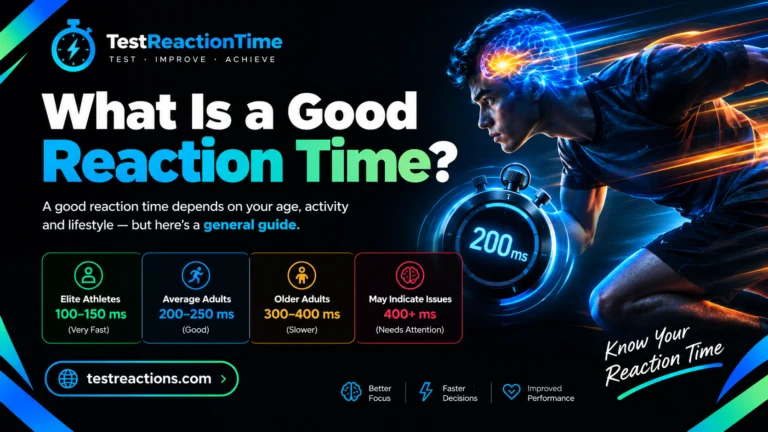
The gap is real and fairly consistent across studies, but it’s worth noting these are group averages, not guarantees. Plenty of non-gamers test faster than plenty of casual gamers. What the research actually shows is a shift in the overall distribution, competitive gamers as a group skew faster, not that every individual gamer beats every individual non-gamer.
Why Correlation Isn’t the Whole Story
Here’s the part that often gets glossed over. Just because gamers test faster on average doesn’t automatically prove that gaming caused it. Two things get tangled together in this kind of comparison, and separating them matters.
Practice effects. Competitive gaming genuinely trains fast visual processing, quick decision making under pressure, and precise hand eye coordination, all of which overlap directly with what a reaction time test measures.
Selection bias. People who already have naturally quick reflexes or strong visual attention may simply be more drawn to fast paced, competitive games in the first place, and more likely to stick with them long enough to get good. In other words, some of that speed advantage might exist before the gaming even starts, not purely because of it.
Controlled training studies, where researchers take non-gamers and have them practice action games for a set period, do show real improvement in related visual skills. But the size of that improvement varies quite a bit depending on the game type, how much practice was involved, and exactly what was being measured. It’s fair to say gaming helps. It’s not fair to claim gaming improves reaction time by some fixed, guaranteed percentage for everyone who tries it.
Why Gamers Tend to Test Faster
A few overlapping factors explain the gap, and none of them are mysterious once you break them down.
Extensive repetition. Competitive players rack up hundreds or thousands of hours reacting to fast, unpredictable in-game events. That kind of repeated practice genuinely builds faster, more automatic neural pathways over time.
Sharper visual processing. Fast paced games train players to pick out important visual information quickly while filtering out everything irrelevant on a busy screen, a skill that transfers reasonably well to simple click based reaction tests.
Better hand-eye coordination. Gaming constantly demands translating what you see into precise, split second physical movement, which strengthens the same coordination that a reaction test is essentially measuring.
Trained focus under pressure. Competitive play, especially anything ranked or team based, forces players to maintain sharp attention while under real stress, and that stress tolerance carries over into staying quick and composed during a timed test.
Which Games Actually Move the Needle
Not every game builds this skill equally, and it’s worth being specific here rather than lumping all gaming together.
Fast paced shooters like Counter-Strike, Valorant, and Call of Duty tend to produce the largest measurable improvements, since they demand constant split second aiming decisions and rapid responses to visual cues appearing anywhere on screen.
Competitive team games, including MOBAs like League of Legends and Dota 2, along with fighting games, build a similar mix of fast decision making and hand-eye coordination, just spread across a slightly different set of in-game demands.
Rhythm games, think osu! or Guitar Hero, build timing precision and reaction speed through their beat driven mechanics, and surprisingly hold up well as a reaction training tool despite feeling completely different from a shooter.
Puzzle and strategy games, while genuinely great for memory and problem solving, tend to offer far less benefit specifically for raw click reaction speed, since they’re built around slower, more deliberate thinking rather than split second responses.
Can Non-Gamers Catch Up?
Yes, genuinely. You don’t need to grind competitive shooters for years to see real improvement in your reaction speed.
Regular, focused practice with a reaction time test on its own has been shown to produce measurable gains, often somewhere in the range of ten to thirty percent improvement after several consistent weeks of practice, and the key word there is consistent, not occasional. If gaming itself appeals to you, spending thirty to sixty minutes a few times a week playing a fast paced action title can absolutely help too, though it’s not strictly necessary if targeted testing and practice already fit your routine better.
Beyond direct practice, the same lifestyle factors that help everyone’s reaction speed apply here as well. Solid, consistent sleep, regular physical activity, and generally good nutrition all support the kind of nervous system performance that shows up as a faster click on a test, gamer or not.
Typing and Clicking: The Advantage Isn’t Just About Reaction Time
Gaming’s influence shows up in a couple of related skills too, worth a quick mention since they often get tested alongside reaction speed.
| Skill | Gamers | General Population |
|---|---|---|
| Typing speed | 50 to 80 WPM | Around 40 WPM |
| Clicks per second | 8 to 16 CPS | 5 to 7 CPS |
The typing gap makes sense once you think about it, competitive gamers spend enormous amounts of time on a keyboard, which naturally builds familiarity and finger dexterity even outside of dedicated typing practice. The clicking gap is even more pronounced, since competitive players sometimes deliberately train specialized techniques like jitter clicking or butterfly clicking specifically to push their clicks per second higher for certain games.
Professional Gamers: As Fast As It Gets
At the very top end, professional esports players represent close to the ceiling of what human reaction speed can realistically achieve. Their measured averages routinely land in the 120 to 180 millisecond range, putting them in similar territory to fighter pilots and Formula One drivers, groups whose careers also depend heavily on split second reaction speed.
That level of performance comes from an enormous combination of practice volume, specialized training, finely tuned low latency equipment, and in some cases, simply natural aptitude that got them drawn to competitive gaming in the first place. It’s genuinely impressive, but it’s also a useful reminder that this is the extreme outlier end of the scale, not a realistic benchmark for casual comparison.
Frequently Asked Questions
Do gamers really have faster reaction times than non-gamers?
Often yes, especially action and competitive players, though the gap reflects group averages rather than a guarantee for every individual.
Does playing video games automatically improve every type of reaction?
No, the benefit is strongest for visual reaction and hand-eye coordination specifically, and transfers less reliably to unrelated real-world tasks.
Could selection bias explain some of the gap?
Yes, people with naturally quick reflexes may be more drawn to competitive gaming in the first place, alongside any genuine training effect.
Can someone who doesn’t game still improve their reaction time?
Absolutely, consistent practice with reaction tests alone can produce meaningful improvement without ever picking up a controller.
Which games help reaction time the most?
Fast paced shooters and competitive team games tend to offer the biggest measurable benefit, more so than puzzle or slower strategy games.
Are gamers faster at typing and clicking too?
Yes, though the advantage varies, typing speed gaps are moderate while clicking speed gaps tend to be much larger.
Final Words
Gamers being faster isn’t just internet folklore, there’s real, consistent data behind it. But the honest picture is more layered than a simple headline, part practice, part natural aptitude that draws certain people toward competitive gaming in the first place. The genuinely good news is that the door isn’t closed to anyone. Whether you game regularly or not at all, focused, consistent practice with a reaction time test, paired with decent sleep and a bit of patience, can move your own number in a real, measurable direction.